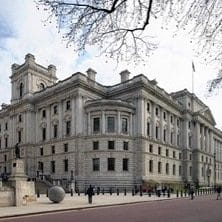
Treasury: AML plans protect legally privileged material
Law firm owners and managers will be subjected to the Financial Conduct Authority’s (FCA) ‘fit and proper’ test once it takes over oversight of their anti-money laundering (AML) activities, the government has decided.
It sought to reassure the profession that strong information-sharing between the FCA and legal regulators would minimise the risk of duplication.
It also ruled out giving the FCA the power to access legally privileged material as part of its work.
HM Treasury yesterday published the outcome of its consultation [1] on the powers the FCA will have once it takes over as the AML and counter-terrorism finance (CTF) supervisor for lawyers and accountants, the timing of which has yet to be confirmed.
The response [2] said the FCA would be responsible for registering firms carrying out AML/CTF‑regulated activity and maintaining a public register of them.
A new beneficial owner, officer or manager of a law firm currently obtains Solicitors Regulation Authority approval by providing a Disclosure and Barring Service check and a five-year address history.
But HM Treasury said it would require them to pass the FCA ‘fit and proper’ test, which looks more broadly at integrity, competence and compliance history.
Most of the opponents to this were from the legal sector, who argued that it was “unnecessary, duplicative, and incompatible with existing regulatory frameworks”, the response said.
“Many noted that solicitors, barristers and other legal professionals already undergo rigorous statutory fitness and propriety assessments, and warned that a parallel FCA-administered test would add cost and friction without providing additional AML benefit.
“Concerns were also raised that FCA testing could interfere with the independence of legal regulators or contradict their decisions, leading to uncertainty over who has primacy in assessing professional suitability.”
HM Treasury disagreed, however. The test reflected “the high-risk nature of these sectors, as identified in the National Risk Assessment [3], and the importance of consistent gatekeeping across the AML/CTF supervisory system”.
But to ensure a smooth transition to the FCA, “the government expects the FCA to be able to make use of existing checks where appropriate and to operate processes that avoid unnecessary duplication”.
Among the FCA’s supervisory tools will be the power to appoint a ‘skilled person’ to conduct a review addressing a specific area of concern and to issue directions to firms, while enforcement powers will include civil sanctions and criminal proceedings.
The FCA will assume responsibility for issuing and approving guidance, although the work will be done by a reconstituted version of the current Legal Sector Affinity Group.
Acknowledging objections from the legal sector, HM Treasury said it would not “at this stage” introduce new legislative requirements to mandate the sharing of suspicious activity reports directly with regulators.
Lawyers argued that such reports were principally an intelligence tool for law enforcement and that broader access risked undermining confidentiality, privilege and the confidence of those submitting them.
The FCA and the legal regulators will have to establish information-sharing and co-operation arrangements.
“These arrangements would support a more joined-up supervisory system, minimise duplication for firms, and enable effective two-way exchange of information across both AML/CTF and wider regulatory functions,” HM Treasury said.
“This framework would be underpinned by appropriate safeguards, including protections for legal professional privilege, data protection requirements and confidentiality obligations.”
It said documents required for routine AML/CTF supervision “would not generally attract legal professional privilege, and that the existing protections for privileged material will continue to apply”.
This means the FCA will not be able to use its information-gathering powers to require disclosure of any privileged document.
“However, it is essential there is a clear understanding between the FCA and legal professionals on what documentation will be required during a supervisory visit, and, for example, how they should handle instances in which privileged information needs to be redacted from a relevant file without creating unnecessary complexity.
“The FCA will put guidance in place to ensure there is clarity on what documents are required and how it will handle issues of privilege when they arise.”
The response noted the concern that “criminally complicit or wilfully negligent legal professionals would falsely claim privilege to withhold documents from supervisors”.
It said: “The government is committed to upholding legal privilege, including protecting it from abuse. The FCA will therefore ensure it is prepared to utilise prescribed processes through the courts where necessary to prevent this abuse.”
The law will impose a duty for supervisors to co-operate with each other and a clear information-sharing gateway, “so files on investigations and enforcement actions can be shared”.
Despite concerns about overlap, the government decided against a statutory limit to the FCA’s role, leaving it to the individual agreements it reaches with each regulator.
The requirement to share information and co-operate “will ensure that supervisory and enforcement decisions can be coordinated between regulators, minimising the burden on firms and limiting the risk of dual-regulation.
“This information-sharing regime should also be used to coordinate the production of evidence and ensure that the work undertaken by the FCA in investigating wrongdoing can be used by regulators in other contexts, such as considering whether a solicitor should be struck off.”
On the fees the FCA will charge firms to cover its costs, “many stakeholders… emphasised that firms already pay significant regulatory fees to existing [regulators] and, in some cases, the economic crime levy. Respondents cautioned that introducing FCA fees without reductions in costs elsewhere risks firms paying duplicative or overlapping regulatory fees”.
The fee structure will be determined through a further consultation, HM Treasury said.
It will also retain the economic crime objective added in 2024 to the statutory objectives the Legal Services Act, namely to promote the prevention and detection of economic crime
“Economic crime risks facing the legal services sector extend beyond money laundering and terrorist financing alone, which includes fraud, sanctions breaches, bribery and tax evasion.
“Retaining this objective ensures that legal services regulators continue to have a clear statutory basis for promoting the prevention and detection of these harms, in line with the wider public interest and the integrity of the legal sector.”
The response stressed that both HM Treasury and the FCA “recognise the distinctiveness of the new sectors and jurisdictions that will be brought under FCA responsibility” and that it would “not take a ‘one size fits all’ approach to supervision”.