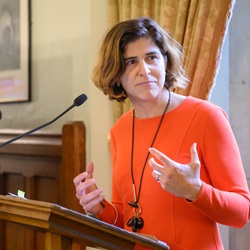
Justice minister Sarah Sackman speaks at the report’s launch
The body that supports almost 700 advice agencies around the UK has called for national strategies in England, Scotland and Wales to tackle a “severe and growing workforce crisis”.
AdviceUK said data from its members showed that the average advice service needed three more advisers to meet demand, having lost that number in the past year.
Demand for free independent advice had “surged”, with case management data showing that cases in 2024–25 were 40% higher than the average for 2018-2022.
Nine in 10 advice services reported major recruitment and retention difficulties, and that they urgently needed more staff, while only 11% felt confident that they have the resources to continue operating beyond the next year.
“The advice workforce crisis is also driven by ongoing funding insecurity, lower salaries and working conditions across the sector,” the charity said.
“Many agencies, particularly smaller ones, rely on short-term funding, which can prevent them from long-term planning, investing in staff development and offering more competitive salaries.”
Chronic underinvestment had “left the pipeline of new entrants too thin”, and the workforce older than the wider economy.
This depth of experience was “a huge strength”, but without a steady flow of new trainees and funded supervision to grow capacity, services would “struggle to replace long-serving, knowledgeable staff when they leave”.
Advice-specific qualifications were not essential to work in the sector, and only 27% of advisers reported holding one in AdviceUK’s 2025 member survey. However, training and qualifications were “an important component in delivering high-quality services”.
Most agencies were also reliant on volunteers, and agencies needed to strengthen their contribution by building on and expanding routes for volunteers wanting to become paid members of staff.
In the report Advice Works: Building a skilled advice sector workforce [1], AdviceUK called for the UK, Scottish and Welsh governments to adopt a national advice workforce strategy, developed jointly with the sector.
The charity said similar strategies had “worked in other fields”, for example the early years workforce strategy.
“Although strategies should be held nationally, proposals should be tested and piloted regionally in line with other employment programmes.”
The strategy should include a “jobs and careers service pathway” to “channel jobseekers and career-changers, including people with lived experience of the welfare system or personal debt, into training and then placements as paid advisers”.
This should be combined with other initiatives, such as marketing and careers promotion to attract new entrants, an expansion of advice sector apprenticeships, and support for advice agencies to participate in employment programmes.
The report added: “Managers in the sector report often being pulled into frontline delivery due to capacity gaps, so it is essential they are resourced to take the time needed to focus on recruitment and development.”
Liz Bayram, chief executive of AdviceUK, commented: “It is time for governments to recognise advice as a key partner in public service delivery and show leadership in ensuring people are attracted to and stay in the advice workforce.”
Speaking at a parliamentary launch of the report, justice minister Sarah Sackman KC said: “We as MPs work all the time with the advice sector… the advice they [are] able to provide to support citizens was absolutely invaluable.
“If we don’t act on the warnings in this report, we are going to lose some of our best people. We are not going to be able to attract the next generation into the advice profession, we are not going to retain many of the brilliant people we have, people are going to burnout and walk away, and that will leave too many of our clients disempowered, it will leave them vulnerable.”