Posted by John Anderson, founder of Legal Futures Associate Somuna

Anderson: Two key levers to pull
If your cost-per-click has crept up again this year, you’ve probably assumed the market simply got more expensive. Everyone’s paying more, so you pay more too, and the marketing budget absorbs it because the enquiries still come in.
That’s the wrong way to read what’s happening, however.
Every pound you spend defending a paid position is a pound that isn’t building anything that outlasts the campaign – while a competitor spending less on PPC (pay per click) and more on owned visibility is quietly compounding an advantage that doesn’t switch off when their budget does.
This article looks at the two most important levers you can pull to change that: how tightly your account is actually managed, and how much you’re building outside PPC altogether.
Here’s an example of how those two levers played out for a client of ours over the last year:
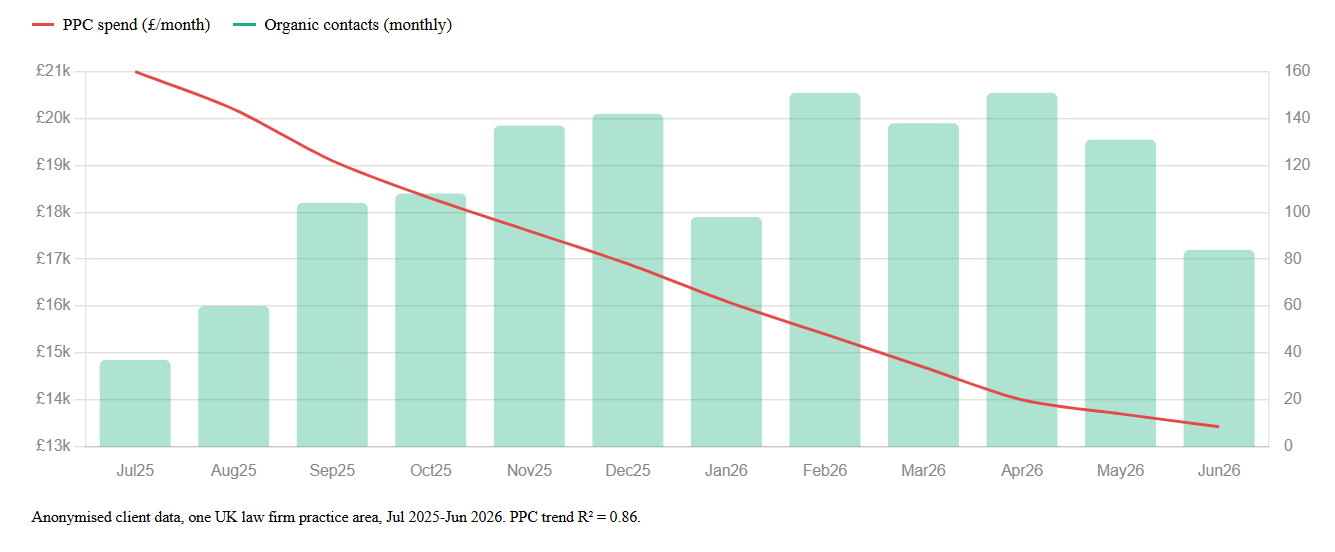
In this graph, PPC spend is on the way down, organic contacts on the way up. It’s worth keeping this shape in mind, because we’ll come back to it once we’ve unpacked why it happens.
What’s actually driving the price up
Personal injury is the clearest example, but the mechanism shows up anywhere competition is fierce. Cost-per-click on injury-solicitor keywords now sits between £15 and £50 per click, and the buyers pushing that price up aren’t only other law firms.
Claims management companies and aggregator platforms bid aggressively on the same terms, often with a different economic model entirely – they don’t need to win a case to profit, they only need to win the click.
Layer automated bidding on top of that and the effect compounds. But it’s worth being precise about where the inefficiency actually comes from, because part of it isn’t market pressure at all – it’s account management.
Account management
Google’s own ‘Optimisation Score’ will not help you reduce costs. It is visible in every ad account and looks like a measure of how well run a campaign is. It isn’t. It’s a measure of how many of Google’s recommendations you’ve accepted.
Accepting them by default doesn’t optimise an account – it hands control to a system whose incentive is your spend, not your cost-per-lead.
If your response to that is simply ‘increase the budget’, then you’re overspending.
The firms getting better cost-per-lead year-on-year tend to share one trait: someone on their account is actively questioning every new campaign type and bid strategy Google pushes, weighing each recommendation against the risk of absorbing irrelevant traffic.
That distinction – active management versus default acceptance – is a critical driver of PPC lowering the cost of your enquiries as your competitors pay more.
Two firms bidding on identical keywords, facing identical competition, can end up with very different costs per lead based on nothing more than whether their account manager treats Google’s recommendations as instructions or as a starting point for negotiation.
Even a perfectly managed account, though, is still buying something that disappears the moment you stop paying for it.
Understand what your spend is not buying you
PPC buys you a position for exactly as long as you keep paying for it. The moment the budget stops, the visibility stops. Nothing compounds. Nothing carries forward. You start again from zero next month.
Compare that to what happens when a firm invests instead in the assets that earn visibility rather than rent it – which is not hard. Especially with AI taking a bigger share of online search results.
The ingredients are
- Named, credentialled authorship on content;
- Structured data that tells search engines and AI systems exactly what the firm does and who its solicitors are; and
- Content that directly and clearly answers the questions real clients are asking.
Sure, that work is a bit slower. It doesn’t produce next week’s enquiries. But it compounds. An article that earns a citation in an AI Overview or gets recommended by ChatGPT keeps earning that citation without a daily budget behind it.
A firm spending everything on PPC and nothing on those owned assets is, in effect, choosing to keep renting indefinitely while its competitors are slowly buying the building.
The gap compounds in a specific direction.
It’s not a static trade-off where a firm can decide later to switch strategies with no cost to the delay. Every year a competitor builds owned, citable visibility, their cost of acquiring the next client through organic and AI-driven search gets a little lower. Every year a firm relies purely on PPC, their cost stays tied to whatever the market’s rising floor price happens to be.
The two curves move in opposite directions. A firm that starts building owned visibility now is buying itself a lower future cost of acquisition. A firm that doesn’t is signing up to pay this year’s inflated rate indefinitely and next year’s likely-higher one after that.
None of this means PPC is a mistake
For many practice areas, especially where the sales cycle is short and the searcher’s intent is immediate, paid search is still one of the fastest ways to generate enquiries, and abandoning it abruptly would be its own kind of risk.
The mistake is treating it as the entire strategy rather than one lever among several.
I advise all firms to plot their cost per acquisition for PPC over the last five years, or whatever you can manage. Most firms will be alarmed by the trend and the way things are heading.
Where this bites hardest
Personal injury shows the clearest numbers because the cost-per-click data is so visible, but the same dynamic plays out anywhere a practice area has commercial claims management or aggregator interest – some conveyancing and immigration keywords show a similar pattern.
Even outside those areas, any firm competing hard in a crowded local market will recognise the general shape: rising costs to defend the same position, year after year.
Heavy consolidation is another key factor. I have seen this first-hand after helping a former client go through a private equity buyout. That happened years ago, and since then the firm has acquired others and become the dominant player in their sector. They have deep pockets and so can outbid most competitors.
Any sector with heavy consolidation like this is vulnerable to PPC inflation and smaller firms being priced out.
The question worth asking
This doesn’t require an audit or a strategy overhaul to start answering. It requires one question, put to whoever manages your marketing: What percentage of our enquiry pipeline currently comes from paid channels versus organic and referral, and is that ratio moving in the direction we want?
If nobody can answer that with a number, that’s the actual finding.
Let’s have a look at that graph again…
Most firms have never asked their agency to report the split that way, because PPC and SEO tend to get reported as two separate line items rather than as two different answers to the same underlying question: how expensive is it going to be to win our next client, this year and in five years’ time?
Naturally a good PPC manager is essential (as was absolutely the case in the above example).
Firms that never ask that question don’t necessarily lose today. But they are absolutely financing their competitors’ longer-term advantage every time the cost-per-click ticks up and the response is simply to pay it.
That distinction – active management versus default acceptance – is a critical driver of PPC lowering the cost of your enquiries as your competitors pay more. Two firms bidding on identical keywords, facing identical competition, can end up with very different costs per lead based on nothing more than whether their account manager treats Google’s optimisation score as a starting point for negotiation or an instruction to follow.