Posted by Damian Bradley, partner and head of legal operations at Legal Futures Associate Express Solicitors [1]

Bradley: DCP is malfunctioning
The latest civil justice figures [2] look deceptively upbeat. Small‑claims trials now average 41 weeks, and fast, intermediate and multi‑track claims sit at 55.9 weeks – six weeks faster than last year.
But anyone working in the system knows these numbers mask a deeper truth: people are still waiting more than a year for justice, and the courts remain nowhere near fit for purpose.
The Consumer Legal Association, whose board includes Express Solicitors CEO James Maxey, has already sounded the alarm. Its chair, David Whitmore, warned that while year-on-year improvements are welcome, the quarter‑on‑quarter deterioration “gives some cause for concern”.
He added: “A median wait of 55.9 weeks still means people whose cases reach trial are waiting more than a year for justice… For injured people, delay can hold up compensation, rehabilitation, treatment and adaptations. Further improvement is needed.”
That is the reality behind the supposedly improving numbers. A year-long wait for justice is not justice. And for many claimants, the wait is far longer.
Digitisation isn’t delivering justice – it’s delivering new problems
The Damages Claims Portal (DCP) was designed to be the solution. Instead, it has introduced a new wave of semi-automated errors and hard‑coded decisions that no judge ever intended.
Express Solicitors recently had a claim listed for trial, followed by two applications that the ‘system’ wrongly listed as trials instead of interlocutory hearings.
When an erroneous deadline for the hearing fee wasn’t met, the DCP automatically struck out the entire claim. It took two months to undo the damage caused and the claim has been delayed by a further six months as the original trial date was lost.
This is not modernisation. It is malfunction.
And communication with the courts has become even harder. The centralised helpline leaves practitioners on hour-long holds, only to be told staff cannot access DCP documents and cannot transfer calls to local courts unless the hearing or trial is imminent.
The alternative, raising a ‘query’ on the DCP, can easily take two weeks for a response to be received. Urgent issues on these claims simply cannot be resolved in this environment.
It is as if the system has been purposely designed to discourage contact with the court rather than enabling the same.
The postcode lottery lives on
Express Solicitors’ regional analysis shows stark disparities:
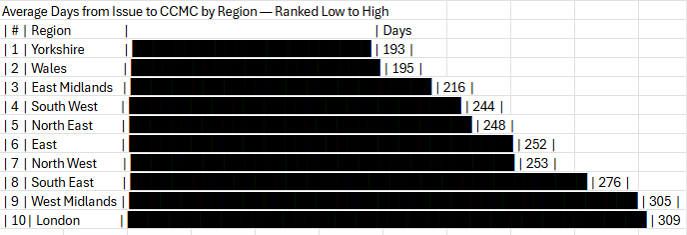
- Yorkshire leads with 193-day delays.
- Wales has improved dramatically to 195 days.
- London has fallen to last place at 309 days.
- Canterbury and Bournemouth & Poole, as specific courts, report catastrophic delays of 488 and 477 days respectively.
Judicial shortages particularly in the South-East and South-West continue to cause delays with frequently postponed costs and case management conferences (CCMCs), trials and application hearings. As James Maxey put it, “for many claimants, the system is not slow – it is stalled”.
The truth: justice delayed is still justice denied
The headline quarterly figures help sustain the government narrative that digitisation is fixing the courts.
But injured people are still waiting months, often years, for their claims to be progressed before receiving any compensation, private treatment and rehabilitation. The Consumer Legal Association is right: progress exists, but complacency is dangerous.
Until the DCP becomes reliable, until courts can be contacted directly, until judicial shortages are addressed and regional disparities eliminated, access to justice will remain an aspiration rather than a reality.
There is a session on the DCP at next month’s Claims Futures conference [3].
A note on the data
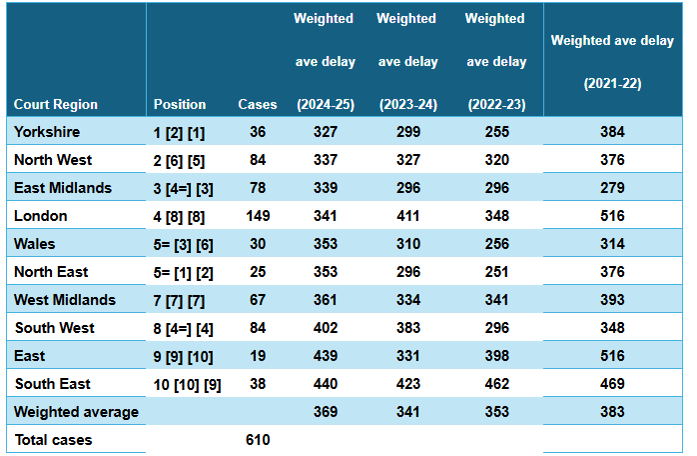
The dataset covers five years of court‑delay rankings, with this year shown in a bar chart and the previous four years in a comparison table. Delays are measured by calculating the number of days between service of the claim form (once the court fee is paid) and the first CCMC.
Because the CCMC is initiated by the court and requires both parties to engage, Express Solicitors considers it the most reliable and consistent way to measure delay.
Although some cases have multiple CCMCs and many proceed to trial, using the first CCMC remains one of the strongest like-for-like metrics for comparing court performance across England and Wales.
Weighted average delay (2025/26)
Historical weighted average delay (2021-25)