Posted by Legal Futures Editor Neil Rose
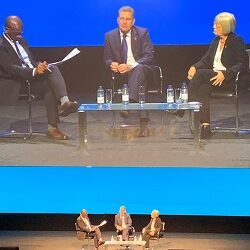
Clive Myrie, Paul Philip and Anna Bradley in action and on the big screen at 2022’s SRA compliance conference
The thousand or so compliance officers gathering tomorrow morning at the Solicitors Regulation Authority’s (SRA) annual compliance conference in Birmingham could be excused for having a distinct sense of déjà vu.
The week before last year’s event, the Legal Services Board (LSB) published a highly critical report into how the SRA had been operating and initiated enforcement action as a result. This year, ditto.
The timing on both occasions was not coincidental, I suspect. But there is, however, one crucial difference between the Carson McDowell reviews of the SRA’s actions in relation to Axiom Ince and SSB Law.
Chair Anna Bradley and chief executive Paul Philip infamously refused to apologise to the profession about the Axiom Ince collapse as they dismissed the LSB report as just opinion. What happened, Ms Bradley told the event, was “in many respects… history for us”.
This year, however, sorry has not been the hardest word. The pair have apologised about the shortcomings in relation to SSB – profusely, by their standards (by which I mean unqualified).
As well they might. Anybody who has read the SSB Law report, or our comprehensive coverage of it, cannot fail to be shocked by the total systemic failure identified. It goes much further and deeper than the problems found with the SRA’s supervision of Axiom Ince.
The SRA’s inability to join the dots between the dozens of complaints it received about SSB over more than three years from June 2020 speaks to a dysfunction that it deeply worrying, especially as it had set up a special group the year before to monitor cavity wall insulation (CWI) claims. Operation Grouse it was called – but shooting season never got underway.
And that’s before we get to the negligence of its forensic investigation of the Sheffield-based law firm in April 2023, giving it a clean bill of health despite several indications that SSB was actually “in dire financial straits”, as the review put it.
Speaking at a press briefing last week, Mr Philip suggested that most of the damage had been done by then. That may well be true, but it’s not really the point.
Other deeply concerning findings included a failure to recognise clients’ vulnerabilities when they complained – despite an SRA policy meant to address this – and even evidence that the SRA treated reports from solicitors more seriously than those from members of the public (not that it made much difference in this case).
Let’s not forget either that, once SSB had gone down, the SRA approved the transfer of its CWI files to JMR Solicitors, a two-partner firm specialising predominantly in conveyancing. A few months later, it collapsed too, after the SRA had issued a notice recommending intervention (but not actually intervened), with the cases then transferred to yet another firm.
Given that many of its CWI clients ended up with SSB only because Pure Legal had gone under in the first place, you wonder what opinion they have of the profession and its regulator.
Indeed, this is the other big difference with Axiom Ince. There has been no huge public outcry about what happened there. Though some £60m went missing, the SRA Compensation Fund has stepped in to recompense many victims – at great cost to the profession, of course – while five men are facing criminal charges.
SSB’s clients cannot turn to the fund, however. The main problem has been that CWI clients – often vulnerable people, whether by reason of age, disability and/or English not being their first language – have found that the ‘no win, no fee’ deals they were sold did not live up their name. (How they were sold them is another troubling issue altogether.)
CWI claims, once touted as the new PPI, have proven to be anything but, with the vast majority losing. After-the-event insurers have cited SSB’s failures/negligence in refusing to pay out, leaving clients liable for five-figure costs awards to defendant insurers.
The insurers seem, in the main, to be acting reasonably – with the encouragement of the SRA, it should be said – in demanding their money but clients are understandably both scared and furious. Some are suing SSB’s professional indemnity insurers and we may hear about progress on that soon.
In the meantime, the SSB Law Victims Support Group has done an effective job in attracting media interest, aided by several MPs from areas particularly affected, like Burnley and Bradford. The pressure is not going away.
There are searching questions in this too for the LSB, whose oversight of the regulators – which is central to its existence – has relied too much on what they tell it (ironically, something the SRA was accused of doing in relation to SSB).
It is against this background that we have to view the SRA’s response. It is easy for journalists to sit in their ivory towers and call for resignations – in politics, this almost seems like a game – but you have to wonder how Ms Bradley and Mr Philip believe they will have any credibility in front of those 1,000 compliance officers tomorrow.
Just as well for them that questions from the floor, once delivered from microphones in the room, are now sent electronically through an app and mediated by a carefully briefed chair.
That Mr Philip retires in a couple of weeks does not absolve him from the need for accountability. It becomes even more risible, frankly, that the SRA board last year extended Ms Bradley’s six-year tenure by two years because this was “not a steady state period for the SRA”. And who’s fault has that been?
The faceless SRA board members should also be considering their positions.
The SRA has described SSB as the canary in the coalmine (although arguably it was actually Pure Legal) and the SRA has been running ever faster to catch up with what has been going on in the volume claims market, with a flurry of announcements in recent weeks.
Everything I hear indicates that, while of course most solicitors are just trying to do the best for their clients while mining a relatively new seam of legal practice, there is a very murky side to what’s going on, especially around funding for these claims.
The SRA alone cannot solve the problem but the market doesn’t work without solicitors. Its role in curbing the excesses is critical. And so public and professional confidence that it is up to the job is critical too.
I wrote last year that the Axiom Ince report marked the deepest crisis the SRA had ever faced. It survived that, largely, but this is worse. Much worse.
The SSB report undermines the very foundations of what the SRA is there to do. Is ‘sorry’ really enough?