 By Ziyaad Ahmed, Co-Founder, of Legal Futures Qanooni AI [1]
Earlier this year, Inspire Legal Group became the first UK firm to integrate Qanooni AI with Actionstep. The team is now reporting roughly a fifty times return on the cost of the platform. That outcome is not a function of the model under the hood. It is a function of where the AI lives. After a Nexian webinar last week with Sarah Blair and Matt Newton, in front of more than a hundred law firms, I am convinced this is the only question worth running on every legal AI vendor before signing a multi-year deal.
The legal AI category now has more than 400 vendors in market, with new entrants arriving every quarter. Sarah Blair, an AI adoption expert with more than two decades in legal IT, summed up the mood inside firms during last week’s Nexian session, titled Claude and Copilot versus specialist legal AI tools, as excitement with a side of paralysis. The most common message she is hearing from her peers, she said, is not which tool is best. It is what they should do next.
The reason the question has narrowed to that is straightforward. The foundation models the entire category sits on top of are improving in public, at speed, and they are the same set of models almost every legal AI vendor is building on. Differentiation at the model layer is going away. Value is moving to where those models can be applied with the most context, which is to say, into the matter itself.
Four architectural choices
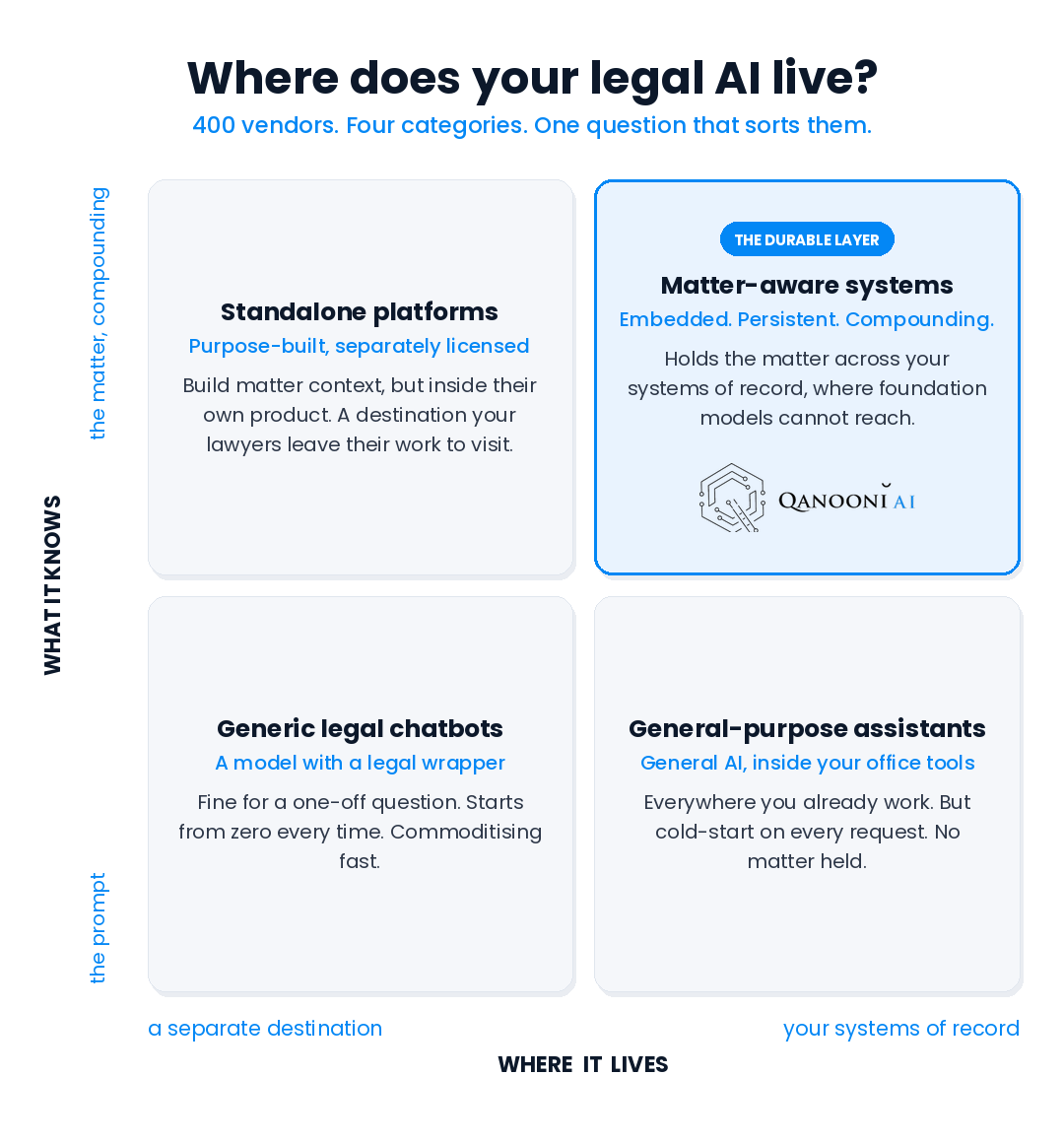
Every legal AI vendor in market today has made one of four architectural choices. Each carries a different trade-off, and each will age differently as the underlying models continue to improve. The view above aligns with the wider Legal AI Value Stack that Sarah introduced into the Nexian conversation, attributed publicly to Helen Fan, an investor and analyst in the category.
A general-purpose assistant inside the productivity suite, such as Microsoft Copilot, gives lawyers access to AI inside the tools they already use. The strength is reach. The trade-off is that those tools were designed horizontally across knowledge work, so legal matter context tends not to persist between requests.
A specialist legal chatbot pairs a foundation model with a legal layer. The strength is speed of access for a one-off question or research task. The trade-off is that as the foundation models continue to improve, the additional value of the legal layer above tends to compress.
A standalone legal platform builds matter context inside its own product. The strength is that it can hold meaningful state and firm-specific structure. The trade-off is that lawyers have to leave the tools they already use to work with it.
A matter-aware system, the quadrant Qanooni occupies, sits inside Microsoft Word and Outlook on the front end and connects on the back end to the systems where the firm’s matters actually live. The strength is durability. The trade-off, candidly, is that it is materially harder to build, which is why we took the time required to get the architecture right before going to market at scale.
Where Qanooni sits, and what Inspire Legal is seeing
Operationally, the architecture comes down to three working parts.
Qanooni meets lawyers where they work, inside Microsoft Word and Outlook, so there is no separate application for fee earners to learn or remember to open. On the back end, the platform connects to the systems where the matter actually lives. That includes practice management platforms, through the Actionstep × Qanooni AI integration. It includes leading document management systems. It includes agreement platforms such as Docusign. The matter context follows the lawyer across all of it, rather than being reassembled from scratch each session.
Every answer the platform returns is grounded in citations drawn from 5,000+ public legal authority databases, traced back to the actual statute, regulation or case law. The model is not asked to recall the law from training data. The system finds the source and shows it. For a sector in which the cost of a hallucinated authority is now a matter of public record, that distinction matters more each quarter.
On top of that we run a layer we call playbooks. A firm’s drafting positions, clause preferences and house standards are encoded once and then applied automatically as lawyers draft, review and reply. The firm position carries across every action on a matter, which means the AI does not need to be re-prompted with context the firm already holds.
Inspire Legal Group is where the architecture is being put through its paces. Earlier this year they became the first UK firm to integrate Qanooni AI with Actionstep, and now run the platform across their legal team day to day. Natalie Foster, the firm’s CEO, summed up the difference in one line that we now use as our internal benchmark for any new deployment.
So Qanooni actually understands my matter.
The return ratio Inspire Legal Group is reporting back is approximately fifty times the cost of the platform. That number is not the result of a single feature or a clever prompt. It is the result of a system that holds the matter as persistent state across the tools the team already runs on, and that gets sharper every time the team closes a file.
The test worth running on every vendor
If I were a managing partner sitting in front of a legal AI demo today, I would not lead with the model under the hood, or with the feature set on the screen. I would ask one question, and run one test.
The question is whether what I am about to sign for the next three years will become more valuable, or less valuable, as the underlying foundation models continue to improve. A platform whose value comes from sitting inside the firm’s systems of record tends to become more valuable as the models below it improve, because the same architecture now has access to better intelligence. A platform whose value depends on the cleverness of its model layer tends to face the opposite dynamic, because the same improvements are also available, by definition, to every other vendor building on those models.
The test is more practical. Pick a real matter that is in mid-flight, not a clean demo file but a messy one a fee earner is actually working on, and ask the system where the matter stands. What is outstanding. What was last agreed. What is coming next. The system will either show you that it knows your matter, or it will not.
If it does not know your matter today, it will not know your matter next year either. Precedent is the key intellectual property a lawyer has. It is the only asset inside the firm that genuinely compounds over time, and it lives across the matters the firm has already closed. Any system you buy should be able to know your precedents today and compound with every new one your firm produces tomorrow.
Why this is the conversation now
The reason this is now the conversation publicly, and not eighteen months ago, is that the model layer has reached a level where firms can no longer distinguish vendors on raw capability alone. Differentiation is moving up the stack, towards the systems where the matter sits. The Nexian session last week, watched live by more than a hundred firms, was a useful proof point that the rest of the market is now reading the architecture the same way.
The matter is the only piece of the firm that compounds. It is the only place an AI can be durable.
That is the architecture Qanooni AI is built on. It is the architecture Inspire Legal Group is now reporting back roughly fifty times the cost of the platform on. And it is the question I would put in front of every legal AI vendor before signing anything.