 By Legal Futures Associate Search Acumen
Energy compliance in the commercial real estate sector is slowing, new analysis has revealed, raising concerns of stranded assets and sell-offs.
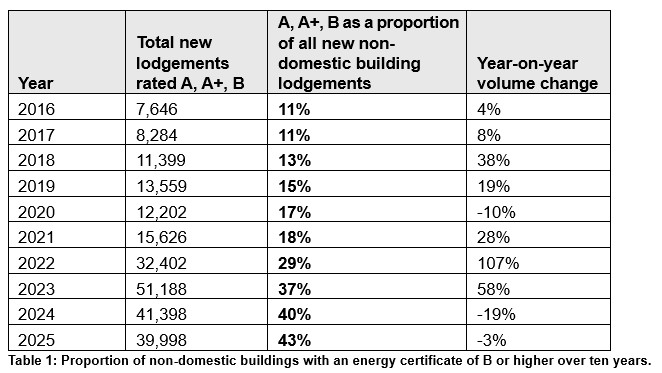
The volume of A, A+, and B EPC registrations, which are typically less energy-intensive and less affected by rising energy bills, had grown at 26% annually until 2024, but in 2025 this slowed to 20% [Table 1]. In fact, fewer A, A+, and B EPCs were registered in 2025 than in the two previous years, down 22% from a 2023 record high.
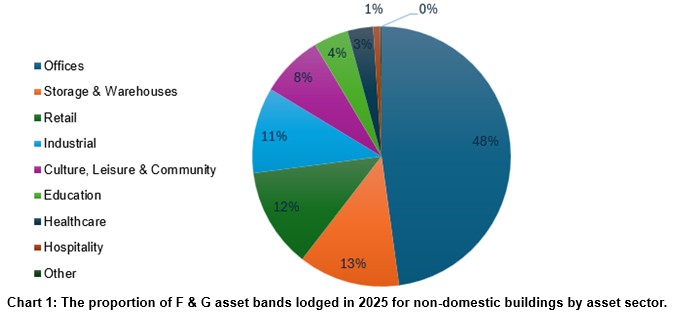
The analysis, conducted by legal technology company Search Acumen, also examined the largest sector contributors by volume to EPC ratings below an E – those that are unlettable unless exempt under the government’s Minimum Energy Efficiency Standards (MEES). The office sector ranked the highest, with more than 3,500 buildings falling into ‘illegal’ bands F and G over the past 5 years [Table 2].
Furthermore, in 2025, the office sector accounted for almost half (48%) of all F and G bands lodged. As oil and wholesale gas prices spike worldwide, operational costs are rising fastest for the most inefficient buildings, making some buildings unviable and at the highest risk of voided tenancies and obsolescence [Chart 1].
In the first two months of this year alone, 200 non-domestic buildings have been registered with an EPC of F or G, rendering a significant proportion unlettable. In 2025, this figure was an astonishing 1,246, only 2% less than the previous year, demonstrating the slow pace of upgrades since 2023, when EPC E compliance became mandatory for all leases.
Andrew Lloyd, Managing Director of Search Acumen, believes that the flight to quality has stalled due to pressured financial markets.
He explains, “A, A+ and B ratings rose significantly from 2020 to 2024, peaking at 61% of all EPCs lodged in 2023. But the rate of decarbonisation of commercial assets has stalled slightly in 2025, which is disappointing to see. Whilst some of the decline could be attributed to delays in registration, it’s likely that, for many, this reflects a cooler financial climate overall, slowing down the race to retrofit.
He continues, “Headwinds from new tax policies and geopolitical uncertainty in recent times are making their mark. Without doubt, the goal of achieving an EPC rating of B or higher in all commercial buildings under MEES by 2030 feels worlds away from our current reality, heightening the risk of stranded assets and transactional complexity.”
“If we look at offices, upgrade costs are huge, often £100–£200+ per sq ft, which often doesn’t stack up financially like it once did. Lenders also tend to penalise more inefficient buildings, so you have a group of buildings fracturing off into unusable states. Whilst some of these office buildings may be vacant, those in use, perhaps under legacy agreements, will be highly vulnerable to rising energy bills. The impact of the Middle East on oil prices and energy markets will be felt for several months, if not years, as supply chains recover long-term.”