 By Legal Futures Associate Access Legal [1]
Conveyancers face shifting risk profiles as the gap between asking prices and final sale values widen in the UK.
New data shows a 22% average discrepancy between asking prices and final sales figures, the largest in a generation, signalling a powerful shift toward a buyer’s market. Because these price negotiations often persist long after instruction, conveyancers are being forced to manage the administrative fallout, increasing the workload per case and eating away at billable margins.
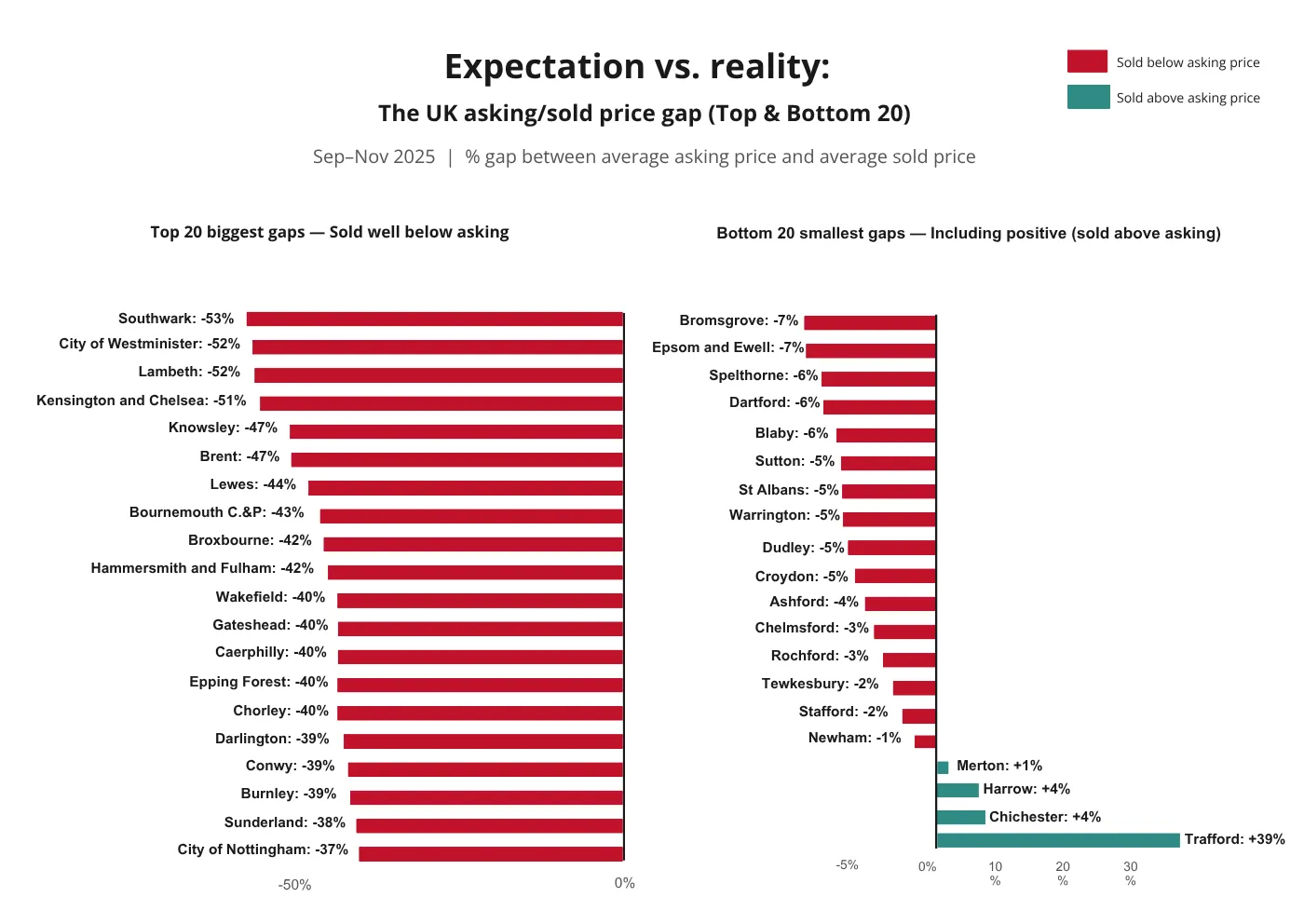
The London borough of Southwark saw the biggest gap, with homes selling for an average of £596,571 – less than half the asking price (-53%) of £1,275,853, for the period September to November 2025.
This isn’t an isolated trend. Of the 161 local authorities analysed, 42 saw properties selling for at least 30% under the average asking price during the same period. After Southwark, the City of Westminster and another London borough, Lambeth, both had the next biggest gaps between sold and asking price data at 52% below. However, it’s not just London. Wakefield, West Yorkshire, Gateshead in the North East, Chorley Lancashire and Caerphilly in Wales, all have a 40% gap between the original asking price and the final sale figure on average.
The research [2] has been published by Legal software provider Access Legal, [3] part of The Access Group, which provides conveyancing software to law firms, to understand the underlying dynamics at play in the UK housing market. It analysed original asking prices and sold prices between September and November 2025 – as well as looking at affordability, energy efficiency and chain dependency data.
As part of the research, Access Legal developed a transaction stress rating designed to help conveyancers anticipate and navigate the structural risks that often lead to deal collapses.
Moving beyond simple price movements, the index provides a practical framework for professionals to assess the fragility of property pipelines by weighting five critical pressure points: chain dependency, market stagnation, EPC liability, price standoffs, and affordability strain. By using these insights to identify high-risk transactions early, conveyancing firms can more effectively manage their workloads, mitigate potential professional risks, and better prepare for the intense negotiation periods that often precede a final completion.
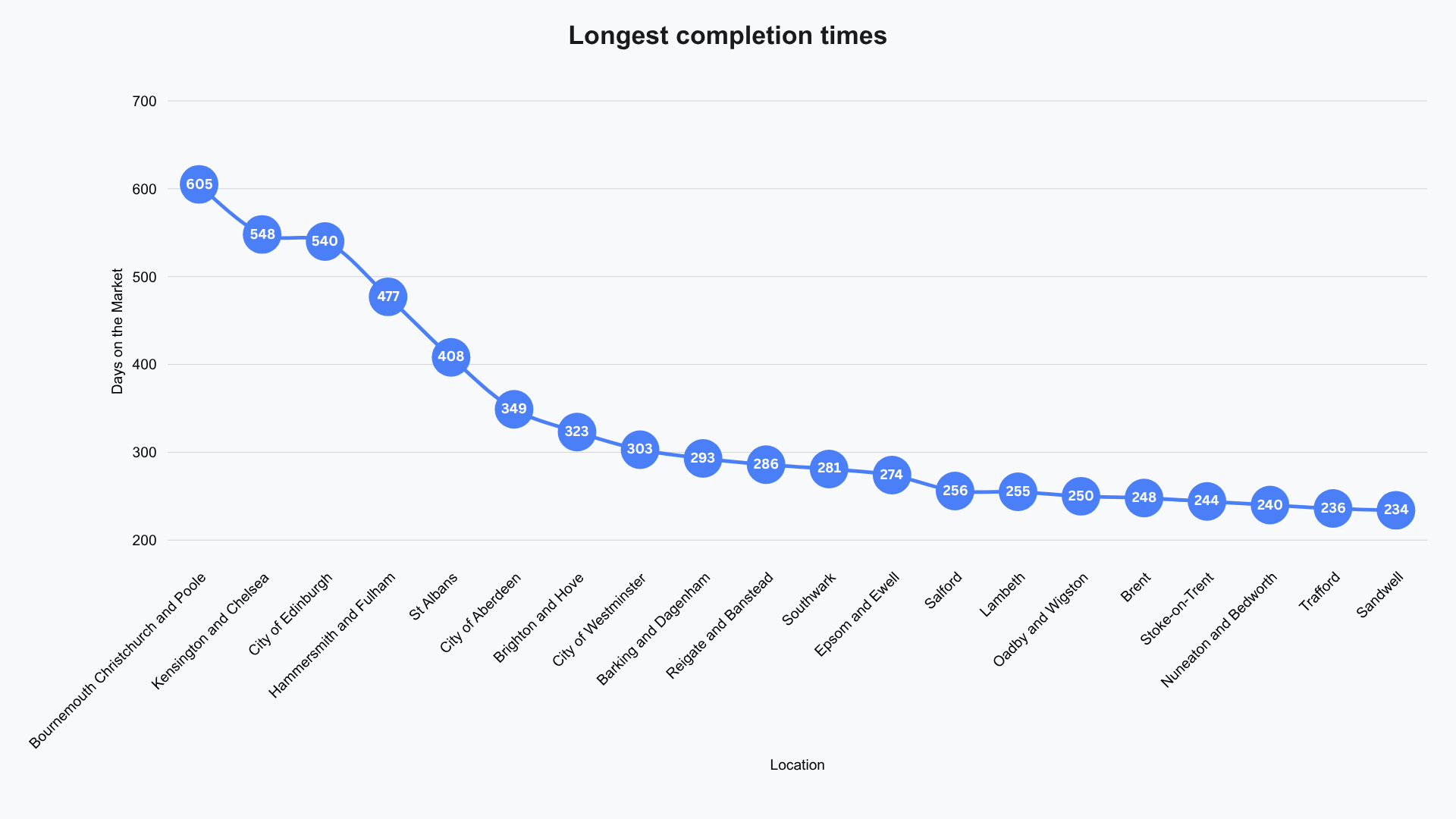
The data reveals Bournemouth, Christchurch and Poole as the UK’s most critical market, driven primarily by severe market stagnation (averaging 605 days). Prime London boroughs follow closely, with Kensington & Chelsea and Westminster suffering from a highly fragile combination of massive price expectation gaps (over 50%) and high volumes of Band D-G homes triggering potentially late-stage renegotiations.
Where are conveyancers feeling the bite?
For law firms operating in these high-stress areas, deals are increasingly defined by high attrition and constant renegotiation, putting intense pressure on legal pipelines:
- Delayed completions and cash flow issues: Soaring ‘days on market’, averaging 155 days (or 22 weeks) nationally but hitting 605 days in Bournemouth, act as a stark indicator of severe pipeline stagnation. For conveyancers, these protracted timelines mean property chains take exponentially longer to build and secure, heavily delaying fee realisation and disrupting firm cash flow.
- Down-valuations: Lenders are acting as the ultimate market enforcers. When surveyors apply strict 2026 affordability metrics to inflated asking prices, conveyancers are left managing 11th-hour price renegotiations to prevent chains from collapsing.
- Expiring Mortgage Offers: Because these transactions are taking so long to get over the line, particularly in severely delayed markets like Kensington and Chelsea (548 days), Edinburgh (540 days), and Westminster (303 days), buyers are increasingly hitting expiration dates on their mortgage offers
Rob Hailstone, CEO of Bold Legal Group and a conveyancing professional with over 50 years of experience, highlighted that the market is in the middle of a price fluctuation:
“This data signals a clear shift in power from sellers to buyers. Higher mortgage repayments are forcing buyers to reassess budgets and negotiate harder, while economic uncertainty and changing investor behaviour has left more properties lingering on the market.
“This has significant implications for conveyancing. Longer transaction times are creating more uncertainty, reducing cashflow and leaving conveyancers managing heavy, unpredictable workloads.
“This is a time for conveyancers to hold their nerve. Transactions and chains need more TLC than usual, so buyers and sellers need conveyancers who are proactive, not reactive.”
Bucking the trend
While ongoing reports show a ‘subdued but stable’ market, this deeper analysis exposes a major ongoing market correction – putting the UK in the heart of a buyer’s market and revealing a median price gap of -22% based on initial listing prices and final HM Land Registry completions.
While the majority of the UK undergoes a correction, a handful of markets are operating at the other end of the scale. Harrow (+3.5%) and Chichester (+4%) have remained largely immune, but Trafford in Greater Manchester bucks the national trend.
Properties in the area are currently selling for an average of £105,000 over asking price, representing a +38.5% gap. This is likely driven by a lack of family housing and highly sought-after grammar schools in areas like Altrincham and Sale, agents are successfully deploying “Offers In Excess Of” (OIEO) strategies.
Why is this happening?
These findings suggest that a stalemate between seller expectations and buyer affordability has reached a breaking point. This deadlock was triggered in late 2022 when average mortgage rates rose from around 2% to over 6% almost overnight, slashing buyer purchasing power just as UK house prices hit record highs – prices which have continued to rise since.
With the Bank of England holding the base rate steady on March 19, average mortgage rates are unlikely to drop significantly anytime soon, with reports they are beginning to rise again.
Though unlike the 2008 financial crisis, which saw an immediate collapse in credit, the current market is defined by a much slower-burn correction, similar to the early 90s where a spike in interest rates created a massive affordability gap. But while 90s sellers were financially trapped by negative equity and couldn’t always afford to lower prices, today’s sellers have had the equity to absorb the hit.
Speaking on the findings, Robin Edwards, who has worked in real estate for over 20 years and is a managing partner at Curetons said; “The gap between asking prices and final sale prices we’re seeing across the UK comes down to a lag between seller expectations and the financial reality buyers are working with now.
“Many sellers are still anchored to pre-2022 valuations when cheaper borrowing significantly increased what buyers could afford. Today with mortgage rates higher and affordability tighter, buyers simply can’t stretch in the same way.
“For buyers this environment creates an opportunity to negotiate more confidently, particularly where a property has been on the market for a while or requires a lot of work. Buyers who are financially secure, chain-free and able to move quickly are in a particularly strong position because sellers are increasingly prioritising certainty over squeezing out the very last bit of price.”
Mike Connelly, Head of Commercial, Conveyancing at Access Legal, said:
“Standard housing indices that rely on asking prices are currently painting an incredibly misleading picture of stability.
“We developed this research because buyers, sellers and legal property professionals need to look past the final asking price to really understand what’s happening between homes going on the market and what they eventually sell for. That 22% average void isn’t just a standard negotiation margin; it represents the harsh mathematical reality check that is hitting the market. We are witnessing a slow correction of the UK housing sector – and with mortgage rates going up once again, this correction is going to last for a good while yet.”
To view the full picture for the average gap between asking prices and completion values across 161 locations in the UK housing market, please visit: https://www.theaccessgroup.com/en-gb/legal/campaigns/uk-buyers-market-price-drops-full-picture/ [2]