 By Legal Futures Associate Search Acumen
In October, top property industry leaders gathered at the annual Digital Conveyancing Summit to discuss key property transaction trends to expect in coming years – discussing everything from council houses to quantum security threats.
Search Acumen held a panel event for its audience of 500 property lawyers, consisting of its Managing Director, Andrew Lloyd; EMEA Executive Director of Technology at JLL, Will Cohen; Executive Director at the Urban Land Institute, Imogen Thompson; and Chief Knowledge & Innovation Officer at Freeths, Nick Pryor.
Moderated by The Financial Times’ Property Correspondent, Julie Steinberg, the panel explored how commercial real estate can future-proof itself against the technological and economic forces reshaping the property and investment markets over the next five years. The panel sparked big questions for the lawyers in the room.
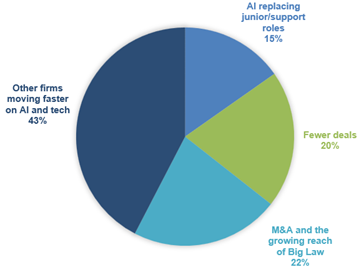
[Graph 1: What is the biggest threat to the commercial success of your law firm currently?]
Speaking on AI, Andrew Lloyd, Managing Director of Search Acumen, summarised, “We haven’t had a technology that is so accessible and transformative since the spreadsheet. Coupled with the fact that property is becoming the Treasury’s most tempting tax base, we will see significant change in the months ahead.”
The year so far – damp squib
Imogen: “Our recent ULI sentiment survey revealed a lot of negativity in the market – this is not just Budget-related. Systemic issues, including interest rates and viability challenges, are slowing economic recovery. People expected a financially better 2026, and that buoyant attitude of January and February has ebbed away.”
Andrew: “The year has still followed the usual seasonal pattern, but increases have been softer than usual. Having expected a year full of excitement, it feels like a damp squib. Firms are still getting quotes for data ahead of big projects but are then delaying their decisions for longer than would have once been standard – we’re seeing clients’ clients delaying their decision-making.
“It points to uncertainty being our new normal, and this is where technology can help navigate these policy changes, from predicting investment behaviour at the top level, to risk mapping a building ahead of a deal to be on the front foot of changing regulation.”
Public sector playing a vital role
Imogen: “At the moment, the public sector doesn’t always have the funding or expertise, whilst the private sector needs the public sector to be on board for unlocking land, securing planning permission and having policy support. I think a huge shift is on the horizon in the volume of public-private partnerships.
“Devolution in particular might deliver some benefits but is not a panacea – if we are going to kickstart growth through public-private partnerships, a holistic view of infrastructure is essential, and we have to understand that real estate is not just housing or commercial buildings but also the infrastructure (social, transport, educational) that supports it. Devolution does offer opportunities for development at a regional scale, but this may raise some challenges from a data standpoint.”
Andrew: “We’ve seen a deliberate policy-led rise of corporate landlords in the social housing sector over the last decade – and are now seeing the reverse through an impetus to move council housebuilding to the public sector. However, it has been 30 years since councils have actually been building at any real scale. At the same time, the new build market is softening because of decreasing land values and sale prices. The result is that public and private sectors will need to work together to meet targets, particularly for those local authority areas that have the most pressing housing needs.
“A key problem is that there aren’t currently any frameworks to enable that to happen and these will need to be created which will take a lot of time: sites must be analysed, titles identified and contracts drawn up with the right legal frameworks.”
Nick: “From a legal standpoint, we are seeing a real push to make this happen. I can see this from our work on social housing, green energy and grid infrastructure across all of our 12 offices which gives us a genuinely national perspective. It is important to think creatively about how to build partnerships because there aren’t really any easy wins and there are a lot of challenging problems to navigate. Data and AI will play a huge role in analysing the lie of the land and thinking about fact patterns when building partnerships.”
Is plug-and-play possible?
Imogen: “I think there are more examples of successful plug-and-play options for our industry than we may have realised which, providing stakeholders can work together, could help to deliver a governance shift. The reality of the situation is that the UK has not been good at learning the lessons of the past, from either success or failures, but context is key and there have been wins.”
Andrew: “We can see some of these opportunities in the mortgage finance sector; the ‘plumbing’ exists, the sector just needs the will to use it.”
Climate change needs data
Andrew: “Real estate doesn’t have an AI challenge; it has a data challenge. There are huge amounts of data, but they are locked away in different places and often not shared. When we think about the climate resilience of our buildings and upcoming retrofit challenges with new MEES targets coming in, data is the only meaningful way of measuring and improving, and will be vital for deals.
“Lenders, for instance, have a huge amount of data that they don’t share during residential transactions, so the same work ends up being done 2 or 3 times per transaction. You can layer that up into commercial, where there is potentially more data, and you could use that to build broader market-driven analytics from the datasets that already exist. This would help with making investment decisions, looking at data geospatially rather than solely making case-by-case decisions. The volume of data to go through is the challenge, but we can use GIS and AI tools to structure this into a more digestible package. The key is to arrive at a structured understanding of data.”
Will: “A data-rich environment should lead to better decision making and to some extent this is a virtuous cycle – the more data that you have on assets, the more that you can build this into models and strategy. This is how you can drive AI to deliver opportunities from investments – climate risk is a good example, as are the costs of retrofitting or data centre build-out given their power and water needs.”
AI race worries 43% of law firms
Nick: “AI and other technologies will allow law firms to get their arms around the facts more fully than was ever possible previously in a much easier and cleaner way, which will allow for more thoughtful, commercial decision-making – either based on the here-and-now or on extrapolation of what the future might look like.”
“In this context, law firms are right to be concerned and get a handle on their technology use. The opportunity is to get our data into a commercially minded, data-information-knowledge-wisdom pyramid. In other words, we can build wisdom through infinite amounts of data with human judgement right at the top.”
Imogen: “It is important to discuss not just the quality of but also access to data. The built environment industry is typically proprietorial and doesn’t share data to maintain a competitive advantage. However, after we sourced data on decarbonisation from a number of industry players who are usually tight-lipped, we have been able to create an open-source dataset to help with making better investment decisions – this is really powerful but doesn’t happen often.”
“The next step is to keep building on that so that the industry is built on shared knowledge and transparency, to connect information to the power behind decision-making. Data is only useful when used to inform the best decisions.”
Andrew: “All our data is geospatial – this fixed context unlocks its use. The interoperability problem is the lack of cross-referencing, so we’ve found a consistent way to collect data for single locations. HM Land Registry’s title register uses property descriptions where the Ordnance Survey’s master map uses grid co-ordinates and addressing, so there are two completely different systems underpinning these datasets. Bringing them together is critical, combining location and ownership, which is the most valuable information in the context of transactions. You can then overlay things like climate and flood risk by referencing in other data sets. This is the key to unlocking things by identifying them as a single point on the planet that all the information refers to.
Nick: “The shipping container was one of the keys to unlocking global trade because it gave us a standard measurement. Combined data is today’s equivalent to innovate from. The key to unlocking this potential is standardisation you can build out and around from.
Will: “If everyone uses the same or similar models, this raises the bar in terms of access to good data – great for the industry – but the differentiating factor is owned knowledge and proprietary sources to aid investment advice and efficiency opportunities, which won’t necessarily be uniform. Those that carve out the greatest advantage will be the firms that use their own internal knowledge and internal data sources combined with industry wide data to provide something fresh and new for their clients.”
Imogen: “One great example is retail. I’ve seen an estate amass lots of data points around shopping, now using AI to farm hashtags, to track dwell time and shopping habits through social media to build a clearer picture about their retail portfolio. These are some of the advantages of getting creative with data.”
Will slow tech adoption lead to obsolescence?
Nick: “Central to the opportunity is to find structure in unstructured data. This is why law firms have not previously been able to mirror the digital transformation seen in accountancy because words, unlike numbers, aren’t inherently structured. Transformer models have changed that by allowing people to rapidly derive structure and synthesise that information.
“AI needs to be at the core of how you practice law. Proprietary data held by law firms is confidential by nature, not unlike a bank holding deposits – there are some permissible uses for it, but certainly not complete freedom of action. But with the right protections and infrastructure in place, new data opportunities to organise and predict scenarios more accurately become immediately relevant. It is a constant learning loop, where sticking to the top-level principles is vital.”
Will: “Governance has not kept pace with tech – three years ago less than 5% of organisations were piloting AI but now at over 95%. Less than 40% of organisations who are starting to pilot AI have formal training or governance processes in place.
“There is a whole separate ecosystem needed around AI that sits outside the platforms and the technology itself, around how we can and should use it. From a legal perspective, there should always be a discussion around what the right human oversight IS and how models are validated against data, and that is without even considering quantum encryption and security in the future.”
Andrew: “Ultimately, our job is judgement, not assembly: AI can inform decisions, but never make those decisions.”
Future trends
Will: “The challenge from quantum as well as advancing agentic models is important to keep on the horizon, both in driving real opportunities and value as well as cyber protection and risk considerations. If AI is 5G, quantum is light speed – by 2035 normal encryption won’t cut it. But, how can crash-strapped public bodies protect against this evolving landscape? I think we’ll see more shared datasets being used by public and industry bodies and freely available, helping the responsible development of a standardised base.”
Nick: “AI is helping us mitigate against proportionate risk. There is a lot of opportunity at the moment – grid reform, social housing, data centers – and AI and data has to help us optimise those. It’s about treating AI as core infrastructure and not an add on.
“Equally, questions still need to be answered thoughtfully about how far you can leverage the data that law firms have. Legal AI labs are giving lawyers practical experience and peer-led learning – we’ll undoubtedly see more of this.”
Imogen: “For Real Estate, it is still a trust and handshake business – AI is just the best tool in your arsenal.”
Key takeaways for property lawyers from the panel
- Treat AI as core infrastructure, not an add-on
- Harvest data now, exploit later: think about NDAs and data holding for this strategy
- Property is still a ‘trust and handshake’ business – relationships matter
- Prepare for more complex partnership transactions within the public sector
- Climate change data is vital to investors; don’t get left behind