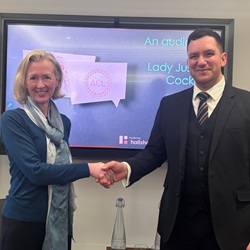
Lady Justice Cockerill with ACL chair David Bailey-Vella
The costs budgeting ‘lite’ pilots have proven popular with both judges and users in their first year, and are likely to be expanded to other courts, the Deputy Head of Civil Justice has revealed
Speaking at an Association of Costs Lawyers at Inner Temple, Lady Justice Cockerill also revealed that two Civil Justice Council costs reports were due to be published soon – one on reform to the costs provisions of the Solicitors Act 1974, and the other introducing guideline hourly rates for barristers and a new rate for the biggest and most complex commercial cases.
The Civil Procedure Rule Committee (CPRC) introduced budgeting pilots on 6 April 2025 in the Leeds, Manchester and Rolls Building Business & Property Courts, and for business and property work in the Leeds, Manchester and Central London county courts.
“It has been very, very popular amongst judges and, outside of London, it has been very, very popular generally,” Dame Sara said, in the ‘ACL in Conversation’ event, conducted by Legal Futures editor Neil Rose.
“We have seen suggestions that people are issuing in locations where they can access cost budgeting lite rather than in the other district registries. You can anticipate that it will be brought back to CPRC with a view to wider rollout, certainly across district registries.”
She acknowledged the view that it takes as much time to draft a lite budget as full one, but “it is cutting down on cost management hearings and will cut down ultimately on cost”.
She urged practitioners to provide the rule committee with feedback to inform its decision on expanding the pilots.
The Solicitors Act working group, headed by Mr Justice Adam Johnson, is considering recommendations for primary legislative reform to the Solicitors Act 1974; the use of a general order under section 56 of the Solicitors Act 1974 to support the development of a more effective scheme for non-contentious costs; a potential costs regime for online digital portals; and the scope of future reform in relation to contentious and non-contentious costs.
“The legislation hasn’t really kept pace with developments and the status quo has made everybody very unhappy,” Cockerill LJ said.
Dame Sara said the report on guideline hourly rates, while a less complicated issue, had been more contentious. “Guideline hourly rates for barristers were a bit of a shock to a number of people, but the CJC has managed to get some very good data to consult on.”
There was also “a degree of contention” about whether having the enhanced rate for heavy commercial was a good idea or whether it would drive costs upwards.
Lady Justice Cockerill said becoming the first female deputy head of civil justice last November was a big moment. “I was of the generation where I thought there will be no more firsts for us by the time we got to the top of the profession So it’s very nice for there still to have been one for me to pick off.
“I think it is very important because it is a role which possibly has quite a male vibe to it. There’s a lot of committee business, core administration and so on. We have never really seen that area headed up by a woman.”
Dame Sara said priorities in her role included the work of the transparency and open justice board, and digitisation and the work of the Online Procedure Rule Committee.
Part of this was stripping back the rules to make modernisation easier and justice more accessible.
“A lot of the online systems are designed to be used ideally by litigants in person on their mobile phones.
“Part of [Master of the Rolls Sir Geoffrey Vos’s] vision is that people will interact with the justice system on digital devices, and the statistics are proving him right – the percentage of people who will respond to a claim made in that way is higher than for the paper equivalent.
“So will we get very different rules? That is the ambition but the devil is in the detail. We’re just finishing the drafting of the core OPR rules and it’s very difficult to draft rules that are both clear and authoritative, while covering everything you need them to cover and being accessible.”
This work will filter down to the other rule committees and Dame Sara revealed that the Civil Procedure Rule Committee has decided to revive its simplification project.
ACL chair David Bailey-Vella commented: “It was fascinating to hear Dame Sara’s journey into law, her thoughts on civil justice and plans for the future.
“She has recently been involved in the biggest costs budgeting exercise in English legal history, the Pan Nox Emissions litigation, and so is now well versed in the challenges that costs can provide. We look forward to working with her to make the system work better.”
The event was sponsored by Hailsham Chambers.