


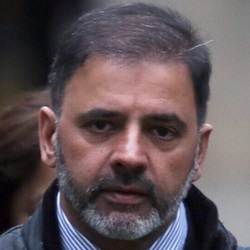
Ghaffar: Explanation for opening account “not capable of belief”
A barrister has failed in a bid to overturn his conviction for defrauding the Legal Aid Agency by falsely claiming defence legal costs.
Rasib Ghaffar, who was also a part-time judge, was jailed for three years in 2024 but sought to challenge his conviction by introducing new evidence from three witnesses.
The Court of Appeal rejected the application, questioning why they were not called at the trial and also finding their evidence would not support an appeal anyway.
Mr Ghaffar was found guilty of conspiring to inflate legal fees and work claimed for in 2011 and 2012 together with solicitor-advocate Azhar Khan, solicitor Joseph Kyeremeh, and legal clerk Gazi Khan.
All were convicted of conspiracy to commit fraud by false representation.
Mr Ghaffar pleaded not guilty but was convicted in February 2024 and sentenced that May. His appeal against sentence was rejected.
The prosecutions followed a substantial police investigation into fraudulent claims for defendants’ costs orders submitted to the Legal Aid Agency’s national taxing team on behalf of acquitted defendants in criminal proceedings in Crown Courts.
Some of the payments made to Mr Ghaffar were through a company called Kandi Consulting. It was not disputed that Mr Ghaffar had opened its bank account but his defence was that the payments had nothing to do with him and were instead made to a legitimate business providing litigation support services and run by Farhad Hussain.
He said he had opened the account on behalf of Mr Hussain because he was unable to open his own business account. Mr Hussain later became a named signatory.
Mr Ghaffar sought adduce fresh evidence from Mr Hussain but Mrs Justice Jefford, giving the court’s unanimous ruling, described the “complete absence” of any business records from Kandi Consulting and any independent evidence of the business in operation as “remarkable” – and all the more so because he was first expected to give evidence nearly five years ago.
She said that, even if there was credible evidence of Mr Hussain conducting some sort of business, “it is of very little weight in supporting any case that the payments in issue were for services provided by this business”.
Mr Ghaffar’s explanation for opening the account was also “inherently incredible” and involved a bank “having no difficulty with an account being opened in the name of one person (whose account it is not) but with the intention that it is run by someone else who is unnamed and has a sufficiently poor credit history that they could not open the account in their own name”.
Jefford J said neither the evidence that Kandi Consulting was a genuine business run by Mr Hussain nor the explanation of the bank account in Mr Ghaffar’s name were “capable of belief”.
Even if the court were wrong on this, it was not enough for a ground of appeal. The majority of the monies received by Mr Ghaffar came from unrelated sources and the jury would have convicted him on these anyway.
Further, there was no “reasonable explanation for the failure to adduce the evidence at trial”.
Jefford J concluded: “Taking all these factors into account, it is patently neither in the interests of justice nor expedient for the court to receive this evidence.”
The court held similarly over evidence from Mohammed Tahir Khan, who in 2010 was working as a caseworker at Arora Lodhi Heath Solicitors, one of the firms involved in the fraud. Mr Ghaffar had his chambers in the same building and they were involved in some cases together.
Mr Khan’s evidence was also intended to show that Kandi Consulting was a genuine business but Jefford J said it did not do this: “Mr Khan simply did not know anything about it.”
The third witness was Tina David, who said she had worked for Kandi Consulting at the time. “Again there is no reasonable explanation for the failure to adduce this evidence at trial,” said Jefford J.
It was “nonsensical” for Mr Ghaffar to suggest that he had not known her full name and was not aware that she could have provided supportive evidence.
“It was always relevant and important to the applicant’s case to adduce evidence that Kandi Consulting was a genuine business carrying out work on the Miah case. Anyone engaged by Kandi Consulting and working on the case was a potentially helpful witness.
“Even if the applicant did not know the names of those working on the case, he could and should have asked Mr Hussain to provide details.
“Alternatively, had any evidence been obtained from Mr Hussain as to what work was being done and by whom, the defence would have been led to Ms David as a potential witness. In fact, nothing was done.
“Taking this factor into account alongside the very limited weight that could be attached to her evidence, we see no reason to conclude that the court should receive this evidence.”











Leave a Comment