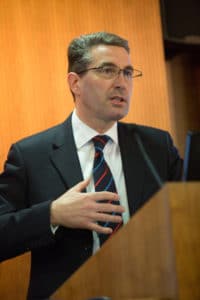
Philip: economic decision
The Solicitors Regulation Authority (SRA) is anticipating a bump in claims on its compensation fund as a result of solicitors becoming involved in dodgy high-yield investment schemes, it emerged yesterday.
It came as the value of open claims on the fund – which compensates clients for losses suffered due to their solicitor’s dishonesty and default – rose to £42m in 2016.
Last year, the SRA warned both the profession and the public about solicitors giving credibility to fraudulent investment schemes by operating as “middlemen”, and Richard Collins, its strategic planning and performance director, said that the risk to the compensation fund was one of the drivers behind that move.
In a press briefing after yesterday’s SRA board meeting – from which the press and public were again excluded – Mr Collins predicted that claims on fund “may well increase” as a result of investment schemes.
A report on the year to 31 October 2016 showed that the fund made grants worth £10.3m, down from £17.9m in the previous 12 months.
At the same time, grant recoveries – generally from client accounts of firms shut down by the SRA and the costs of those interventions paid by the solicitors involved – were £10.9m, an increase of £3.9m from 2015.
Recoveries are often received several months or even years after the initial grant is paid and therefore are not necessarily related to grants paid in the same year due to the accounting policies adopted.
The fund received 1,504 claims in 2016, up from 1,174, and closed 1,397 (1,430 in 2015).
There were 399 open claims, 107 more than the previous year, worth a total amount of £42.1m; however, the amount that will actually be paid out will be substantially less for various reasons.
Mr Collins said there was no particular rhyme or reason behind the ups and downs in the numbers, although he suggested that the increase in claims was due to the nature of the some of the firms closed down by the regulator in the preceding 12 months.
Meanwhile, chair Enid Rowlands and chief executive Paul Philip batted away renewed complaints about the decision to hold board meetings behind closed doors for the first time since the SRA was created, offering journalists instead a post-meeting briefing and introducing other outreach channels to engage with the public.
Though journalists were initially told that the new arrangement, which was first used in March and had only its second outing yesterday, would be in place for six months before it was reviewed, Mr Philip revealed that the board had discussed the decision that day and “will not reverse it”.
Confusingly, he then said that it would be “constantly under review”.
Mr Philip also dismissed concerns that the decision to use just one external law firm, Capsticks, to handle all of its legal work – which has now been confirmed – meant that decades of experience of previously instructed lawyers would be lost.
While he said Capsticks provided plenty of experience too, Mr Philip explained that it had essentially been an “economic decision”.
“We’ve let them go because we anticipate significant savings,” he said.
Finally, the SRA has issued a consultation on the regulations it needs to introduce the framework of the new qualification regime for solicitors, which was announced in April.